

Employee bone health screening rarely makes the top of a wellness wish list. Flu shots, step challenges, and mental health days usually get the spotlight. Yet bones quietly carry every employee through every shift, every commute, and every weekend soccer game with the kids.
Picture a project manager in her early fifties. She feels great. She hits the gym twice a week. Then she slips on a wet parking ramp and breaks her wrist. The X-ray reveals something nobody saw coming: thinning bones that had been weakening for years. Six weeks of leave follow, plus physical therapy and a team scrambling to cover her workload.
Stories like this are far more common than most employers realize. According to the Bone Health and Osteoporosis Foundation, about 10 million Americans have osteoporosis, and roughly 44 million more have low bone density that raises their fracture risk. Most have no idea because bone loss causes no symptoms until something breaks.
That is exactly where workplace bone health screening earns its place. A quick, radiation-free scan done right at the office can flag bone loss early, while there is still plenty of time to act with exercise, nutrition, and smart lifestyle changes.
In this guide, you’ll learn what employee bone health screening involves, why REMS technology makes it practical for busy teams, what the results actually mean, and how a single screening day can help shape a healthier, more productive workplace.

Why Workplace Bone Health Screening Belongs in Your Wellness Strategy
Bone loss is often called a silent disease, and for good reason. There’s no pain, no warning light, and no obvious sign until a fracture happens. By then, recovery can take months.
For employers, that silence carries real costs. A 2007 study in the Journal of Bone and Mineral Research projected that osteoporosis-related fractures would cost the US more than $25 billion a year by 2025. The CDC reports that more than 300,000 older adults are hospitalized for hip fractures every year. Some of those costs land on employer health plans. The rest show up as sick days, slower productivity, and lost expertise when key people are out.
Not every cost appears on a claim form, either. Someone recovering from a fractured wrist may be back at work but typing with one hand, skipping client visits, or quietly struggling through the day. That kind of reduced output is hard to measure, but every manager feels it.
Employee bone health screening flips the script from reaction to prevention. Instead of waiting for an injury, companies give people a clear picture of their bone strength today. It’s a small investment that says a lot about how much an organization values its people.
Bone Loss Isn’t Just an Older Adult Problem
Many people assume bone health only matters after retirement. In reality, bone mass peaks around age 30, and gradual losses can start soon after. For women, the drop speeds up sharply around menopause. The Bone Health and Osteoporosis Foundation notes that women can lose up to 20 percent of their bone density in the five to seven years following menopause.
Men aren’t off the hook, either. They tend to lose bone later and more slowly, but they’re also less likely to be screened, which means problems often go unnoticed until a fracture.
Workplace bone health screening reaches people in their 30s, 40s, and 50s, the exact years when early action makes the biggest difference. A baseline scan at 35 becomes an incredibly useful reference point a decade later.
The Hidden Risk Factors in Modern Work Life
Modern office life isn’t exactly kind to bones. Long hours in a chair mean less weight-bearing movement, and bones respond to load. Without regular impact and resistance, they slowly lose density.
Sunlight is another quiet issue. Employees who commute in the dark, work all day indoors, and head home after sunset often run low on vitamin D, which the body needs to absorb calcium. A study in Nutrition Research found that around 42 percent of US adults were vitamin D deficient.
Add rushed meals, high stress, irregular sleep for shift workers, and the occasional smoking habit, and you have a recipe for bone loss that builds quietly over years. The good news? Every one of these factors can be improved once people know where they stand.
What Is REMS, and Why Does It Work So Well at the Office?
REMS stands for Radiofrequency Echographic Multi Spectrometry. It uses ultrasound to assess bone at the hip and lumbar spine, the same sites doctors check with a traditional DXA scan. The big difference? REMS uses zero ionizing radiation.
For workplace bone health screening, that matters a lot. No radiation means no lead aprons, no shielded room, and no hesitation from employees worried about exposure. A portable unit can be set up in a conference room in minutes.
The science holds up, too. A large multicenter study published in Osteoporosis International in 2019 compared REMS with DXA in nearly 2,000 women and found strong diagnostic agreement between the two. REMS also looks at bone quality, not just density, which adds useful detail when estimating fracture risk.
How REMS Technology Actually Works
During a REMS scan, a trained technician glides a handheld ultrasound probe over the hip and lower spine. The device sends sound waves into the bone and captures the raw signals that bounce back.
Instead of relying on a single measurement, REMS analyzes the full spectrum of those signals and compares them with reference models built from thousands of clinical scans. The result is a bone density reading, a T-score, and a fragility score that reflects how strong the bone structure really is.
For employees, the experience is simple. It feels a lot like a routine ultrasound: a little gel, a gentle probe, and a few minutes of lying still.
How an Employee Bone Health Screening Day Works
A typical employee bone health screening day runs smoothly and barely touches the workday:
- A private screening space is set up on site.
- Employees book short time slots around their meetings.
- Each scan takes roughly 10 to 20 minutes.
- Results are explained clearly, in plain language.
- Every participant gets personalized exercise and supplement guidance.
Most people are back at their desks within half an hour. No needles, no fasting, and no radiation.
Understanding the Results: What Do the Numbers Mean?
After an employee bone health screening, each participant receives a report with a few key numbers. The most important is the T-score, which compares their bone density with that of a healthy young adult.
Here’s how the World Health Organization categories break down:
- A T-score of -1.0 or higher is considered normal.
- A T-score between -1.0 and -2.5 indicates osteopenia, or low bone mass.
- A T-score of -2.5 or lower indicates osteoporosis.
An osteopenia result isn’t a reason to panic. It’s a heads-up. Many people in this range can slow or even improve their bone loss with the right exercise, nutrition, and supplement plan. That’s exactly the kind of practical, non-pharmaceutical approach Superior Bone Scanning builds into every report.
Privacy matters, too. Results belong to the employee, not the employer. Companies typically receive only anonymous, group-level insights, such as overall participation, which keeps trust high and makes people far more comfortable signing up.

7 Ways Employee Bone Health Screening Builds a Healthier Workplace
So what does this look like in practice? Here’s how employee bone health screening pays off for both people and the business.
1. Early Detection Through Employee Bone Health Screening
Most people find out they have osteoporosis after a break. Employee bone health screening changes that timeline by catching low bone density and osteopenia years earlier.
Early findings open the door to simple, natural steps like strength training, better nutrition, and vitamin D support. The earlier someone starts, the more options they have. Waiting until after a fracture usually means a longer, harder road back.
2. Fewer Injuries and Less Time Off
Weak bones break more easily from minor slips and falls, the kind that happen on stairs, in parking lots, or on a rainy sidewalk. When workplace bone health screening spots risk early, employees can rebuild strength and lower their odds of a fracture.
Fewer fractures mean fewer long absences, fewer last-minute reshuffles, and smoother operations. For smaller teams, keeping even one key person healthy and present can make a big difference.
3. A Wellness Perk People Actually Use
Gym stipends often go unused. Generic wellness emails get deleted. An on-site scan is different. It’s fast, personal, and gives each employee something real to take home.
There’s also a certain curiosity factor. Most people have never seen their own bone health numbers, and they want to know. Companies that offer employee bone health screening often say it’s the perk people talk about most afterward.
4. Personalized Plans, Not One-Size-Fits-All Advice
Superior Bone Scanning focuses on tailored exercise and supplement plans as alternatives to traditional pharmaceutical treatment. After an employee bone health screening, each person gets guidance that fits their age, results, and lifestyle.
That might mean progressive strength training, which research supports. The LIFTMOR trial, published in the Journal of Bone and Mineral Research in 2018, found that supervised high-intensity resistance training improved bone density in postmenopausal women with low bone mass. It might also mean checking calcium and vitamin D intake against National Institutes of Health recommendations, which call for 1,000 to 1,200 mg of calcium daily for most adults depending on age and sex.
That personal touch is what drives lasting change. People follow plans that feel like they were made for them.
5. Support for a Multi-Generational Team
Today’s workforce spans Gen Z to Baby Boomers. Workplace bone health screening serves all of them: a baseline for younger staff, prevention for midcareer employees, and closer monitoring for those nearing retirement.
This matters more than many realize. About half of women and up to one in four men over 50 will break a bone due to osteoporosis, according to the Bone Health and Osteoporosis Foundation. Reaching people before they hit that age bracket gives them years of head start.
6. Stronger Retention and Employer Brand
Employees notice when a company invests in their long-term health. Offering workplace bone health screening signals care that goes beyond the paycheck.
That goodwill helps with retention, especially among experienced staff who are thinking more about their health. It also gives recruiters something genuinely different to mention in job listings and interviews, which helps attract top talent in a competitive market.
7. Lower Long-Term Healthcare Costs
A hip fracture often means surgery, a hospital stay, and months of rehab. Even a wrist or ankle fracture can lead to imaging, casting, follow-up visits, and physical therapy. Prevention costs a fraction of that.
Employee bone health screening gives companies a practical way to help control health plan costs while keeping people active and independent. It’s one of the rare wellness investments where the human benefit and the business benefit line up so neatly.
A Real-World Picture: One Screening Day, Many Stories
Imagine a mid-sized marketing agency with 80 employees. HR books a half-day screening event, and 52 people sign up.
A 34-year-old designer goes in expecting nothing. She learns her numbers are already in the osteopenia range, likely linked to years of skipped meals and almost no strength training. She leaves with a simple plan and starts lifting twice a week.
A 58-year-old operations director, who has never had a bone scan, finds his results are better than he feared. That reassurance alone makes his day. He sets a reminder to rescan in two years.
A 46-year-old account lead with a family history of osteoporosis finally gets the baseline her doctor kept suggesting. She brings the report to her next physical.
Three different people, three different outcomes, one shared experience. That’s the quiet power of employee bone health screening. It meets everyone exactly where they are.
Common Myths About Employee Bone Health Screening
A few misconceptions tend to keep people from signing up. Clearing them up early can boost participation.
“It’s only for older women.” Bone loss affects men and women, and it can start in the 30s. Younger employees benefit from a baseline, and men are often under-screened.
“I’m active, so my bones are fine.” Exercise helps, but genetics, diet, hormones, and certain medications also play a role. Even active people can have low bone density.
“Bone scans involve radiation.” Traditional DXA scans use a small dose of X-rays. REMS uses ultrasound, so there’s no radiation at all.
“If my results are low, medication is the only option.” Not necessarily. Many people, especially in the osteopenia range, can make real progress with targeted exercise, nutrition, and supplements.
Sharing these points in a pre-event email can make workplace bone health screening feel far less intimidating.
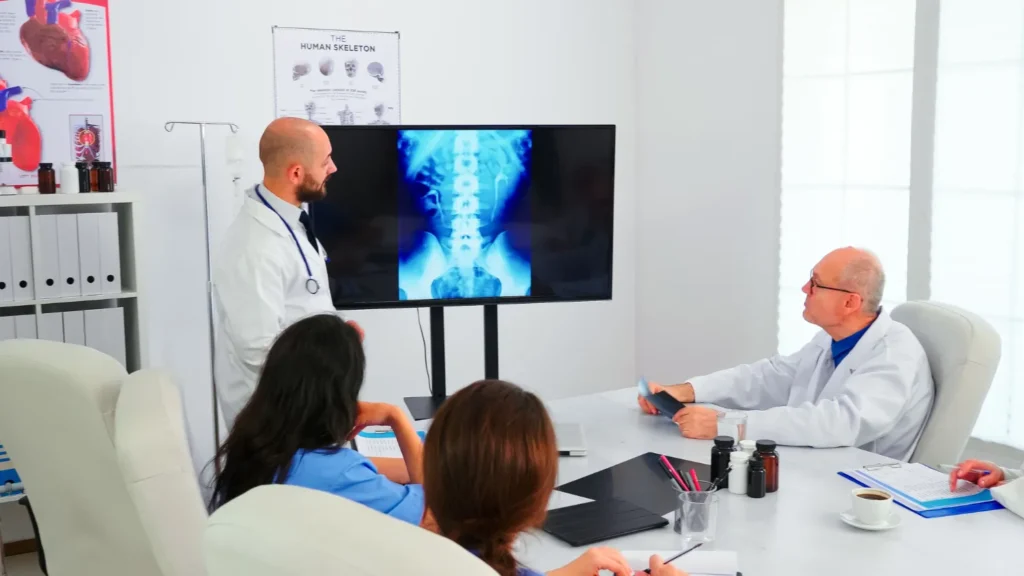
Who Should Join Workplace Bone Health Screening?
Honestly, almost everyone can benefit. That said, some groups gain the most:
- Adults over 40, especially women approaching or past menopause
- Employees with a family history of osteoporosis or fractures
- People who sit most of the day with little weight-bearing activity
- Anyone with low vitamin D, a smoking history, or long-term steroid use
- Younger adults who want a baseline reading
- Staff in physically demanding roles where falls are common
Because REMS is radiation-free, employee bone health screening is a comfortable choice even for people who’d rather avoid repeated X-ray exposure.
Bringing Employee Bone Health Screening to Your Office
Planning is easier than most HR teams expect. Here’s a simple roadmap.
Step 1: Gauge Interest
Send a quick survey to see who wants a scan. Keep it short, two or three questions at most, and mention that the scan is quick and radiation-free.
Step 2: Pick a Date and Space
Choose a quiet, private room with a power outlet and space for a treatment table. Many companies pair employee bone health screening with an existing health fair or wellness week for extra impact.
Step 3: Set Up Time Slots
Online sign-ups keep things organized and prevent long lines. Spread slots across the morning and afternoon so people can fit them around meetings.
Step 4: Communicate Clearly
A few days before the event, send a friendly reminder covering what to expect, how long it takes, and how results stay private. People are much more likely to show up when they know exactly what’s happening.
Step 5: Follow Up
After the event, share general bone health tips company-wide, like simple strength exercises or calcium-rich lunch ideas. Repeat workplace bone health screening every year or two so employees can track their progress.
Tips for Boosting Participation
- Ask leadership to book the first slots. When managers go first, others follow.
- Share a short explainer on why bone health matters at every age.
- Offer remote and hybrid staff a dedicated in-office day.
- Celebrate participation numbers, never individual results.
Finding Employee Bone Health Screening Near Me in Los Angeles
Searching for employee bone health screening near me in Los Angeles or Southern California? Superior Bone Scanning brings the service straight to you. As LA’s trusted mobile REMS provider, the team sets up at offices, coworking spaces, and corporate bone scanning events across the region.
Whether you manage 20 people or 500, on-site workplace bone health screening can be arranged with very little fuss. The team handles the equipment, setup, and scheduling support, so HR doesn’t have to juggle extra logistics.
Conclusion
Healthy bones rarely get attention until something goes wrong. Employee bone health screening changes that by giving every team member a clear, radiation-free look at their bone strength while there’s still time to act. The payoff is real: fewer injuries, less time off, happier employees, and a culture that puts long-term health first.
It’s also one of the easiest wellness programs to launch. One room, a few hours, and a team that cares.
Ready to bring employee bone health screening to your office? Superior Bone Scanning makes it simple with mobile REMS technology and personalized plans for every participant. Book your workplace bone health screening today and give your team a stronger foundation for the years ahead.
Frequently Asked Questions
What is employee bone health screening?
It’s a quick on-site scan that checks your team’s bone strength at work. It helps spot bone loss early, before a fracture happens.
Is a REMS bone scan safe?
Yes. REMS uses ultrasound instead of X-rays, so there’s no radiation at all.
How long does a workplace bone scan take?
Each scan takes about 10 to 20 minutes. Most people are back at their desks within half an hour.
Who should get a bone density scan at work?
Anyone over 40 can benefit, especially women near menopause and people with a family history of osteoporosis. Younger staff can use it to get a baseline reading.
Will my employer see my bone scan results?
No. Your results belong to you, and employers only get anonymous, group-level insights.